 Bordeaux
 Burgundy
 Champagne
 Rhône
Rhône Napa Valley
 Tuscany
 Piedmont
 Mosel
Mosel Oregon
 Rioja
Rioja California sparkling
 Valais and Lavaux
 England
 Douro
Douro Etna
Etna Mendoza
 Marlborough
 Stellenbosch
 Barossa Valley
 Tasmania
 Beaujolais
 Jura
Jura Alsace
 Loire
Loire Provence
 Ribera del Duero
 Sonoma
 Harga lahan
 Tahun baik dan tahun buruk
 Appellation
 Kebun anggur terkenal
 Wine terkenal
 Siapa yang membuatnya
 Temukan vintage
 Bandingkan wine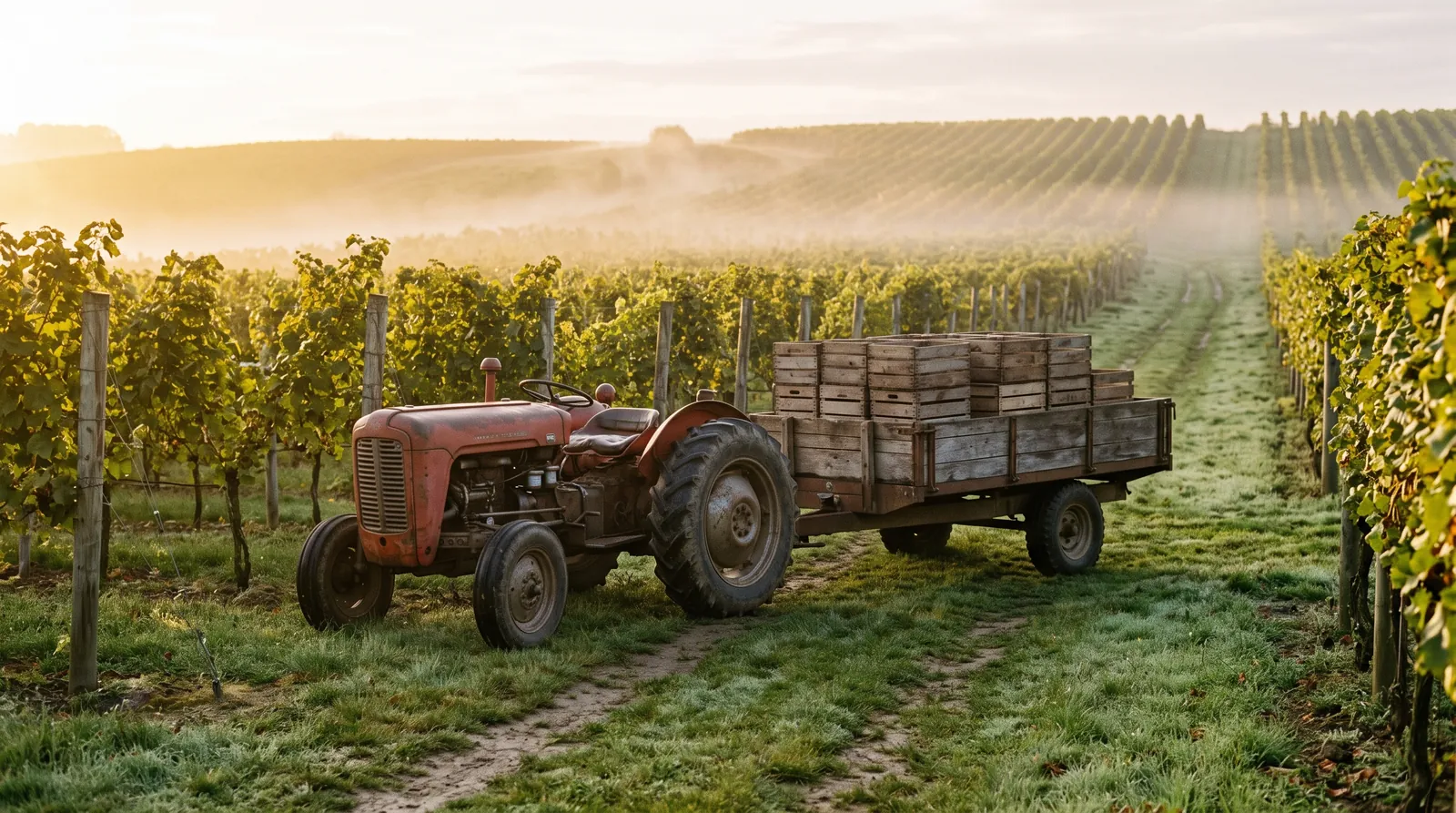
A year in the vineyard
Grapes are picked once a year, but the work never stops. In the Northern Hemisphere, the year runs roughly like this, and each step costs money in labour, fuel or materials.
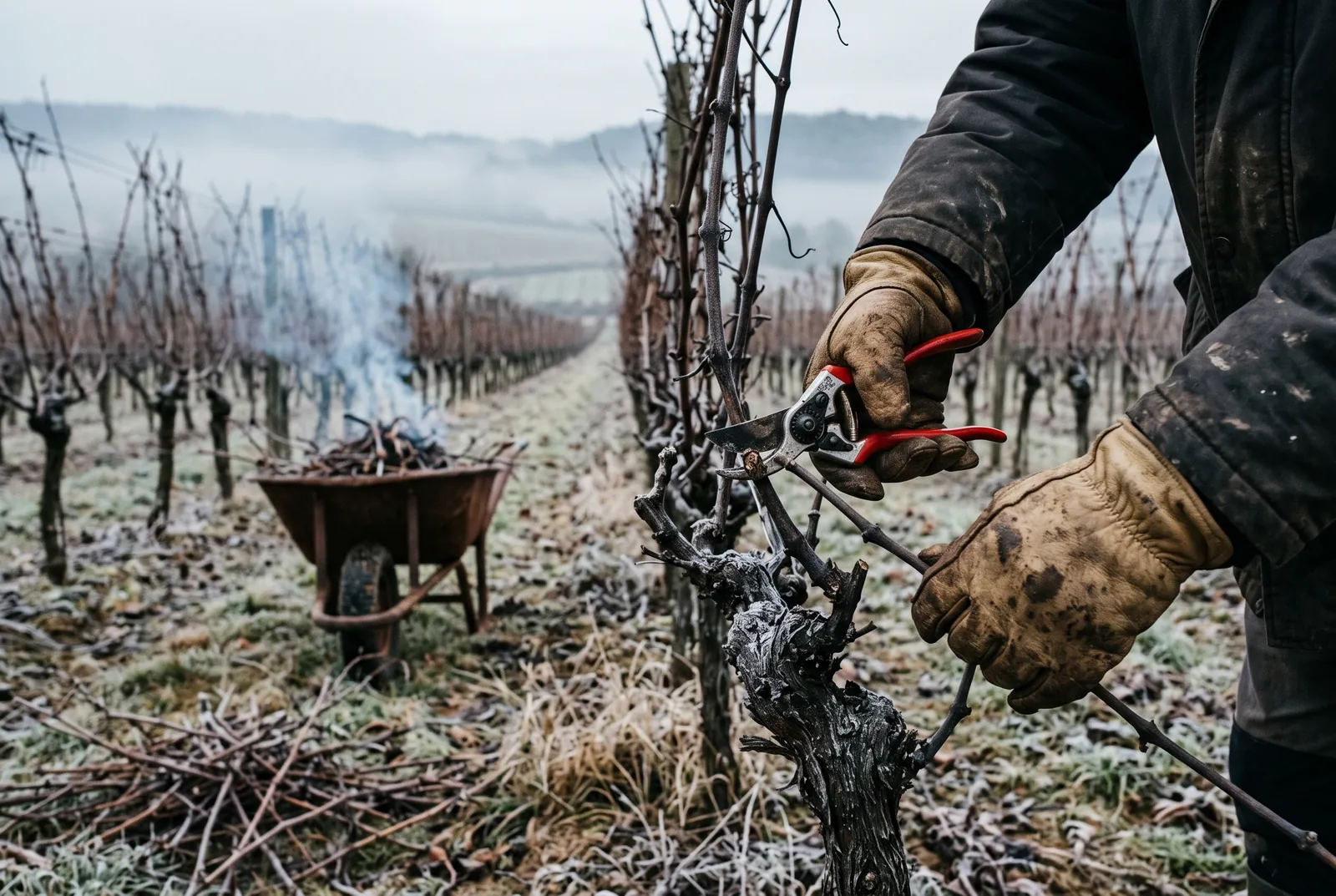
- Winter: pruning. Each vine is cut back by hand, which decides how many buds, and so how many bunches, it will carry.
- Spring: buds break and the young shoots are at risk of frost. Growers tie shoots to wires and start spraying against mildew.
- Early summer: flowering and fruit set. Workers thin leaves and sometimes cut off whole bunches to concentrate the rest.
- Late summer: the grapes change colour and ripen. Growers test sugar and acidity to choose the picking date.
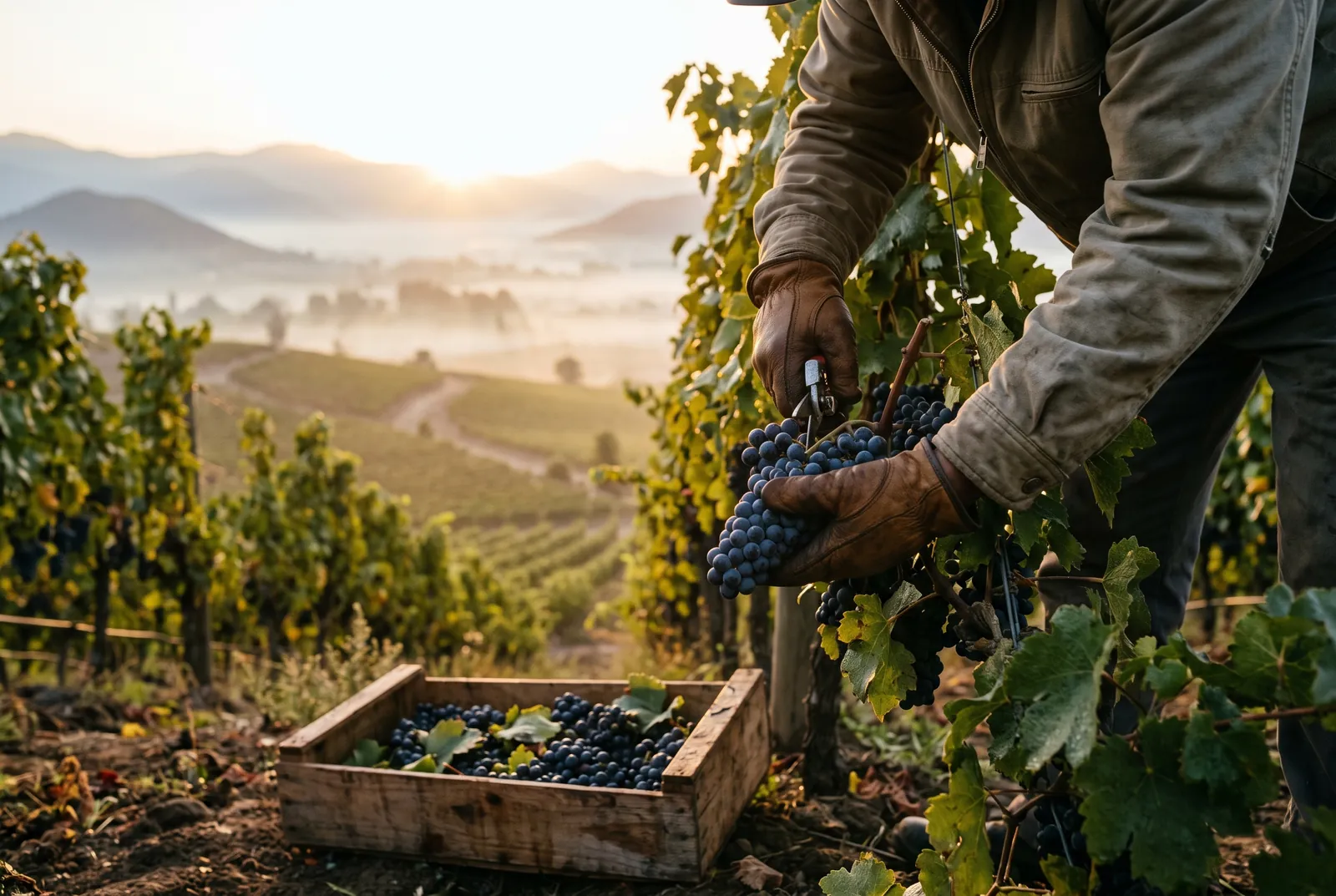
- Autumn: harvest, by hand or by machine, then a final tidy before winter comes round again.
Labour, machines and hands
Labour, meaning the work of people, is usually the biggest single cost in a vineyard. On flat land with wide rows, machines can prune roughly, spray and harvest, and one tractor driver can do the work of many pickers. On steep slopes, such as the Mosel in Germany or the northern Rhône in France, machines cannot go, so almost everything is done by hand and costs far more per hectare.
Hand picking is also chosen on purpose for quality. Pickers can leave rotten or unripe bunches behind, and some wines, such as Champagne and many top reds, are traditionally picked by hand. A machine is cheaper and faster, which matters when a heatwave or storm is coming, but it is less choosy.
Rising wages and the push to mechanise
In many wine regions it has become harder and more expensive to find people for seasonal vineyard work. When the price of labour goes up, economics predicts that businesses will look for ways to use less of it. That is exactly what has happened: more growers now use machines for pruning, leaf removal and harvest wherever the land allows, and new vineyards are often planted in rows designed to suit machines from day one.
This is a good example of substitution: swapping one input for another when relative prices change. A machine is a big fixed cost to buy, but once owned it can cover many hectares cheaply. For a large, flat vineyard that trade often makes sense. For a small, steep plot it usually does not, which is one more reason wine from steep slopes tends to cost more.
Yield: the quality and quantity trade-off
Yield is how much fruit a piece of land produces. Europeans usually measure it in tonnes or hectolitres of wine per hectare; Americans often use tons per acre. A bulk vineyard in a warm, irrigated region might produce several times as much fruit per hectare as a top hillside site.
Many growers believe that a vine carrying fewer bunches ripens them more fully and gives more concentrated flavour, which is why famous appellations often cap yields by law. But this is a trade-off: a choice where getting more of one thing means getting less of another. Lower yields can raise quality and price per bottle, yet they also mean fewer bottles to sell, and the farming costs for the hectare stay much the same. Many of those costs are fixed: they do not shrink just because the crop is smaller.
Think about it: a grower cuts off half the bunches in July. Which of her costs fall, which stay the same, and what must happen to her grape price for this to make sense?
Weather risk
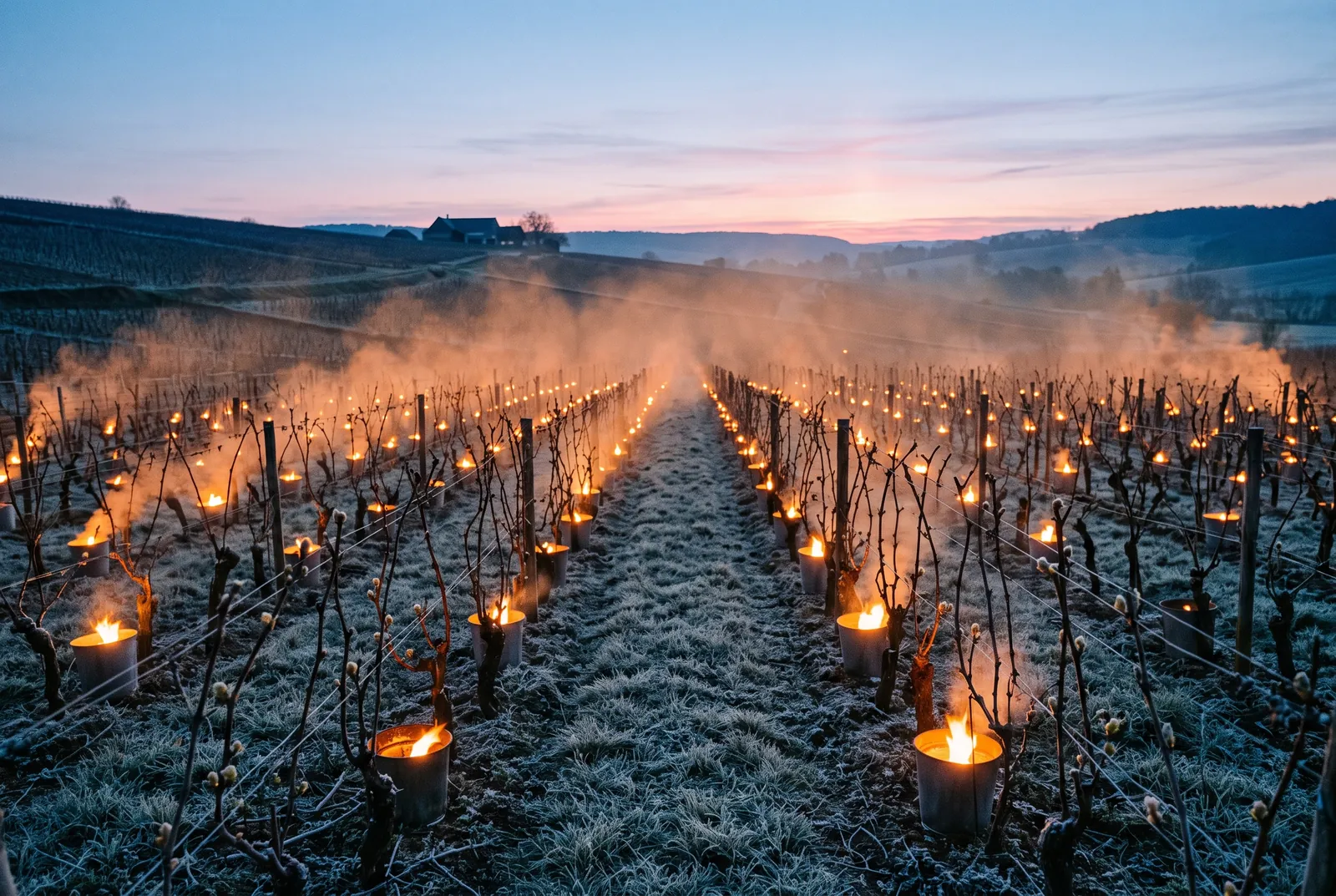
Risk means the chance that things turn out worse than you expected. Farming is full of it. A spring frost can kill young shoots in a single night, which is why some growers light small fires or candles between the rows, run large fans, or spray water that freezes and protects the buds. Hail can shred leaves and split grapes in minutes. Drought stresses vines, and too much rain near harvest can bring rot.
Newer worries include heatwaves and wildfire smoke. Smoke from nearby fires can give grapes an ashy taste, and in bad fire years some wineries in the western United States have turned down grapes they had agreed to buy. A ruined crop still had all the year's costs spent on it.
A bad year also hurts long after harvest. If frost halves the crop, the winery has half as much wine to sell for the next year or more, while its fixed costs carry on. Customers may drift to other brands while the shelves are empty, and winning them back costs money too.
Managing risk: insurance and spreading bets
Growers fight back in several ways. Crop insurance means paying a fee, called a premium, every year to an insurer who pays out if the harvest is destroyed. It turns a possible huge loss into a small, certain cost. Growers also spread risk by owning plots in different places, so one hailstorm cannot hit them all, and by keeping some savings to survive a bad year.
Some of the best public information on what all this costs comes from the University of California, Davis, which publishes detailed cost studies for growing wine grapes in different parts of California. They list every task from pruning to picking, with hours and costs per acre, and are a great place to see real farm budgets.
Newly planted vineyards add one more cost that is easy to forget. A young vine gives little or no usable fruit for its first few years, so a grower who plants a new block pays for land, vines, posts, wires and care for several years before earning anything from it. That is an investment: spending money now in the hope of earning more later, and it is why replanting old vineyards is a big decision.
Worked example: why lower yields raise the cost per tonne
Here is a made-up 10 hectare vineyard with round numbers. Its farming costs are $10,000 per hectare per year, and they stay about the same whether the vines carry a big crop or a small one.
| Pruning, canopy work and other labour | $4,500 per hectare |
|---|---|
| Harvest | $2,000 per hectare |
| Sprays, fertiliser and materials | $1,500 per hectare |
| Machinery, fuel, insurance and overheads | $2,000 per hectare |
| Total farming cost | $10,000 per hectare |
| Cost per tonne at a high yield of 10 tonnes per hectare | $1,000 |
| Cost per tonne at a low yield of 4 tonnes per hectare | $2,500 |
The same $10,000 is shared over 10 tonnes or over 4. Choosing low yields, or losing half the crop to frost, makes each tonne cost two and a half times as much, so the grower must sell those grapes for far more just to cover costs.
Key words
- Tenaga kerja
- The work done by people, and the wages paid for it.
- Hasil panen
- How much fruit, or wine, a piece of land produces, for example tonnes per hectare.
- Trade-off
- A choice where getting more of one thing means getting less of another.
- Fixed cost
- A cost that stays the same however much you produce, like pruning a hectare of vines.
- Risk
- The chance that things turn out worse than you expected.
- Insurance premium
- The regular fee paid to an insurer, who in return pays out if a covered disaster happens.
Check your understanding
Why do steep vineyards usually cost more to farm per hectare?
Show the answer
Machines cannot work on steep slopes, so pruning, spraying and picking must be done by hand, and labour is expensive.
Farming a hectare costs $9,000 and it yields 3 tonnes. What is the cost per tonne? What if it yields 6 tonnes?
Show the answer
$9,000 divided by 3 is $3,000 a tonne. At 6 tonnes it is $1,500 a tonne.
How does crop insurance change a grower's risk?
Show the answer
The grower pays a small, certain premium every year and in return is protected from a large, uncertain loss if the crop is destroyed.
Name two weather events that can ruin a harvest.
Show the answer
Any two of: spring frost, hail, drought, heavy rain near harvest, heatwaves or wildfire smoke.
Go deeper on Corkonomics
Sources and further reading
- Cost and return studies for wine grapes UC Davis Agricultural and Resource Economics
- The Oxford Companion to Wine Jancis Robinson and Julia Harding, eds., Oxford University Press
← Previous chapterAll chapters
All chaptersThe economics of wine production
- The wine business at a glance: from vineyard to glass
- Land: why some vineyard ground costs millions
- Growing grapes: farming costs and yields
- Grape prices: buying, selling and contracts
- Making the wine: winery costs and economies of scale
- Time is money: ageing, inventory and the cost of waiting
- From cellar door to shop shelf: packaging, distribution, taxes and tariffs
- Pricing, brands and the global picture